-
Partager cette page
Projects Our Department Contributes To

- Summary
-
The project develops a physics-informed digital twin integrating experiments, high-fidelity simulations, and machine learning to predict and optimize complex combustion phenomena for fuel-flexible, low-emission energy systems.
- Description
-
September 2024 – February 2026
The transition to CO₂ neutrality requires sustainable combustion technologies alongside electrification. Combustion remains essential in power generation, transportation, and manufacturing, but accurate prediction of these processes is still a major challenge. Current tools for design and optimization are limited.
This project develops a digital twin that integrates theory, experiments, simulations, and machine learning. The approach enables reliable prediction of complex multi-physics systems and supports the design of fuel-flexible, nonpolluting, and energy-efficient combustion technologies. The digital twin is expected to reduce R&D costs and accelerate innovation, with applications in environmentally friendly energy systems and advanced digital design tools.
- Summary
-
Develops a hybrid physics‑based & data‑driven framework combining experiments, high-fidelity simulations, and machine learning for predictive, fuel‑flexible, low-emission combustion modeling. Trains doctoral researchers in sustainable fuels, turbulent flows, data analytics, and AI.
- Description
-
January 2023 - December 2026
The ENCODING project (ENabling Sustainable COmbustion technologies using hybrid physics-based Data-driven modeling) advances decarbonization of energy-intensive industries through cutting-edge combustion research. It establishes a training network for ten doctoral candidates in sustainable fuels, turbulent reacting flow experiments, big-data analytics, and machine learning, fostering interdisciplinary expertise in digital combustion modeling. A hybrid digital infrastructure is developed, integrating experimental and computational data with machine learning to enable predictive capability for fuel-flexible combustion systems.
Key innovations include stable, near-zero-emission combustion solutions for renewable synthetic fuels and efficient modeling techniques that accelerate system design. The approach empowers development of low-emission, energy-efficient combustion technologies while reducing R&D time and resources. ENCODING is funded by the European Union's Horizon Europe research and innovation programme.
- Summary
-
Develops adaptive digital twins that combine experiments, high-fidelity simulations, and machine learning for real-time predictive modeling of complex combustion. Supports fuel-flexible, low-emission, and energy-efficient systems while reducing R&D time.
- Description
-
The LIFETIME project develops adaptive digital twin systems to advance sustainable combustion technologies. It integrates experimental data, high-fidelity simulations, and machine learning to enable predictive modeling of complex combustion processes. The approach allows continuous improvement of models in real time, supporting the design of fuel-flexible, low-emission, and energy-efficient combustion systems. By combining digital and experimental tools, the project reduces R&D time and resources while enhancing system performance and environmental sustainability.
The project targets applications in power generation, transportation, and manufacturing processes where clean and efficient combustion is essential. It is funded under the WEL-T program, supporting high-impact research in Wallonia.
- Summary
-
Developing hydrogen combustion technologies for aluminum recycling furnaces, integrating experiments and digital modeling to enable 100% hydrogen operation, reduce emissions, and improve energy efficiency in hard-to-abate industries.
- Description
-
January 2024 - December 2026
H2AL (Full-scale Demonstration of Replicable Technologies for Hydrogen Combustion in Hard-to-Abate Industries: The Aluminum Use-Case) is a Horizon Europe-funded initiative aimed at decarbonising high-temperature industrial processes. The project focuses on developing and demonstrating hydrogen combustion technologies in the aluminum scrap recycling sector, a key hard-to-abate industry. By integrating state-of-the-art digital tools and experimental techniques, H2AL seeks to develop integrated hydrogen burners and support systems capable of operating with 100% hydrogen in heating furnaces.
The project also investigates the impact of hydrogen combustion on furnace structures and product quality, aiming to minimize emissions and enhance energy efficiency. Through a hybrid approach combining digital modeling and experimental validation, H2AL aims to provide replicable solutions for hydrogen adoption in similar industrial contexts. The project is co-funded by the European Union.

- Summary
-
Develops digital twins for hydrogen and ammonia combustion in heavy-duty engines, combining experiments, simulations, and machine learning. Provides PhD training across Europe in fluid dynamics, thermodynamics, and computational modeling.
- Description
-
June 2025 - 2028
DT-HATS (Digital Twins for Hydrogen and Ammonia Injection and Ignition in Engines for Transport Systems) is a Horizon Europe Marie Skłodowska-Curie Doctoral Network focused on decarbonizing the heavy-duty transport sector. The project aims to advance the use of green hydrogen and ammonia as alternative fuels by developing digital twin technologies for combustion systems. It combines fundamental research, computational modeling, and experimental studies to design innovative solutions for sustainable transport systems.
The network offers 15 fully funded PhD positions across Europe, providing systematic training in fluid dynamics, thermodynamics, machine learning, and computational science. Through secondments at leading industrial and research institutions, DT-HATS aims to enhance career prospects in both academia and industry. The project is coordinated by the University of Perugia, with partners including Université Libre de Bruxelles, University of Stuttgart, City University of London, and others.
- Summary
-
Develops systems to convert biogenic residues into green methanol and use it in high-efficiency air Brayton cycles for electricity generation. Integrates advanced gasification, plasma steam, novel catalysts, and MILD combustion to enhance efficiency and reduce emissions.
- Description
-
September 2024 - August 2027
ResMe2E is a Horizon Europe-funded initiative aimed at transforming small-scale energy production. The project aims to revolutionise small-scale green energy production by developing systems that convert biogenic residues into green methanol and utilise this synthetic fuel in a high-efficiency air Brayton cycle for electricity generation. ULB's involvement underscores its commitment to advancing sustainable energy solutions through collaborative European research.
Key innovations include advanced oxygen gasification combined with plasma steam, novel catalysts for syngas purification, and MILD combustion techniques to enhance efficiency and reduce emissions. The consortium comprises institutions from Belgium, Lithuania, Germany, and Poland, integrating expertise in energy, engineering, chemistry, and computational modelling.
- Summary
-
Develops digital twin models for next-generation e-fuel combustion systems, integrating experiments, simulations, and theory. Focuses on chemical kinetics, turbulence and heat transfer, and real-world applications in power generation, industrial heating, and transport.
- Description
-
The DESIRE project is an ambitious research initiative focused on unlocking the potential of e-fuels through a multidisciplinary approach that integrates experimental, theoretical, and numerical investigations. By addressing key challenges in chemical kinetics, combustion physics, and real-world applications, DESIRE aims to develop cutting-edge digital twin models for next-generation combustion systems.
The research is structured into three scientific work packages: Chemical Kinetics Modelling - developing accurate kinetic models for various e-fuels (NH₃, CH₃OH, H₂, DME, OMEx) to enhance predictive capabilities for combustion performance and emissions control; Physical Processes in Combustion - investigating turbulence, heat transfer, and spray dynamics to refine combustion modelling across industrial applications; Applications and Feasibility - assessing the real-world integration of e-fuels in power generation, industrial heating, and transportation, considering both technological and economic impacts.
- Summary
-
A European network advancing renewable synthetic fuel combustion in energy-intensive industries through experiments, high-fidelity simulations, and hybrid digital twins. Promotes collaboration, knowledge exchange, and innovation across 33 countries.
- Description
-
October 2023 - October 2027
The CYPHER COST Action (CA22151) is a European initiative focused on decarbonising Energy-Intensive Industries (EIIs) through innovative approaches in combustion, fluid dynamics, and data science. With a network spanning 33 countries, including academic experts, industrial partners, and policymakers, CYPHER aims to advance the understanding of Renewable Synthetic Fuels (RSFs) combustion, high-fidelity simulations, hybrid physics-based data-driven models, and self-updating digital twins.
CYPHER is dedicated to accelerating RSF combustion research, developing advanced simulation techniques, fostering collaboration between academia and industry, promoting knowledge exchange and dissemination, and driving innovation for sustainable industrial practices.
- Summary
-
A European network advancing sustainable waste biorefinery technologies to convert biomass and waste into energy and products. Promotes circular economy practices, bioenergy innovation, and collaboration across academia, industry, and policymakers.
- Description
-
October 2021 - October 2025
WIRE COST Action (CA20127) explores sustainable waste biorefinery technologies to convert biomass and waste into energy and marketable products. The project promotes circular economy practices, advances renewable bioenergy, and supports scientific research and innovation in biorefinery systems. It fosters collaboration between academia, industry, and policymakers across Europe to harmonize approaches and accelerate the implementation of bio-based solutions.
The project is structured around working groups focusing on raw materials, conversion technologies, applications, and communication. Funded under the European COST framework, WIRE aims to strengthen the bioeconomy and enable practical, sustainable energy processes.
- Summary
-
Accelerates Belgium's transition to a zero-carbon, sustainable future. Supports collaborative research in decarbonization, sustainable engineering, social equity, and finance, with seed funding for innovative, transdisciplinary projects.
- Description
-
2023 - 2028
SWIFFT – Sustainable World Initiative & Fellowship For Transformation is a multidisciplinary research program focused on accelerating Belgium's transition to a zero-carbon and sustainable future. The initiative supports collaborative research in decarbonization, sustainable engineering, social equity, and finance, combining expertise from academia, industry, and policy. Central to the program is the DeCarbonLab, a hub for experimentation, innovation, and knowledge exchange.
The program also provides seed funding for interdisciplinary projects contributing to societal and environmental sustainability. The program aims to generate actionable solutions for energy transitions while promoting transdisciplinary approaches across technical, social, and financial dimensions.
- Summary
-
Develops AI-based tools and reduced-order models to predict and control urban air pollution. Combines experiments, simulations, and data-driven methods to support sustainable city planning and policy-making across Europe.
- Description
-
January 2023 - December 2026
MODELAIR – Groundbreaking Tools and Models to Reduce Air Pollution in Urban Areas is a Marie Skłodowska-Curie Actions project focused on developing advanced tools to control urban air pollution. The project combines theoretical, experimental, numerical, and data-driven science to simulate, control, and design new disruptive technologies for sustainable cities. The primary objective is to create an Artificial Intelligence (AI)-based tool to assist in making informed decisions for air pollution control in urban areas. This involves developing novel analysis tools and new Reduced Order Models (ROMs) based on non-intrusive sensing and innovative data sources. The research and training network units five European laboratories and four companies across five major European countries.
MODELAIR aims to improve current modeling capabilities by considering the influence of buildings, roads, and other structures on the flow and dispersion of air pollution. The project collaborates with industry and city councils in Madrid, Spain; Brussels, Belgium; and Bristol, UK, to develop transferable outputs that enhance air quality dispersion models, helping city councils and industries in developing new regulations to control air pollution.

- Summary
-
The project developed innovative retrofitting solutions for building envelopes, integrating multifunctional systems like photovoltaics, insulation, and monitoring to enhance energy efficiency.
- Description
-
April 2017 - March 2018
The REINTEREST project was a collaborative initiative aimed at enhancing the energy efficiency of buildings through innovative retrofitting solutions. The project's primary objective was to design a customizable, industrializable methodology for retrofitting building envelopes, such as facades and roofs, with multifunctional and intelligent systems. These systems integrated various functionalities, including aesthetics, waterproofing, photovoltaics, electrical storage, insulation, monitoring, and DC nanogrids, facilitating rapid and straightforward installation from the exterior.
This multidisciplinary collaboration aimed to advance the development of intelligent and multifunctional building envelope systems, contributing to the reduction of energy consumption in the building sector.
- Summary
-
Advanced 3D metal printing for aeronautical components, developing 3D radiography-based quality control to reduce defects and improve sustainability. Focused on defective mechanisms and fatigue analysis under real operating conditions.
- Description
-
July 2020 - March 2023
The AeroCT project focuses on accelerating the adoption of 3D metal printing in aeronautical component manufacturing. It developed advanced quality control methods using 3D radiography (computed tomography) to identify and reduce defects in additively manufactured parts. The project aimed to improve sustainability and competitiveness in the European aeronautical sector.
ULB contributed through its 4MAT and ATM laboratories, focusing on defect mechanisms and fatigue analysis in aeronautical sub-assemblies under real operating conditions. The project also involved ULiège and several small SMEs specializing in additive manufacturing.
- Summary
-
Develops high-performance, sustainable materials for stationary electrical energy storage systems. Focuses on environmentally friendly processes, circularity, and supporting local innovation in collective energy applications.
- Description
-
The BatFactory project is an ongoing initiative aimed at developing high-performance materials for stationary electrical energy storage systems, with a focus on collective applications. The project is financed by the Walloon Region's Recovery Plan and is being conducted by a consortium of universities and research centers.
The project's objectives include the production of batteries and battery components for stationary electrical energy storage and collective applications, utilizing intelligent, environmentally-friendly processes that enhance circularity. The initiative leverages the Walloon region's research and innovation expertise to support the development of local businesses and contribute to sustainable energy solutions.
- Summary
-
Develops a digital twin for a hydrogen-to-grid living lab to optimize system operation and maximize local green energy use. Integrates experiments, simulations, and physics-based models across electrolysers, turbines, engines, and heating networks.
- Description
-
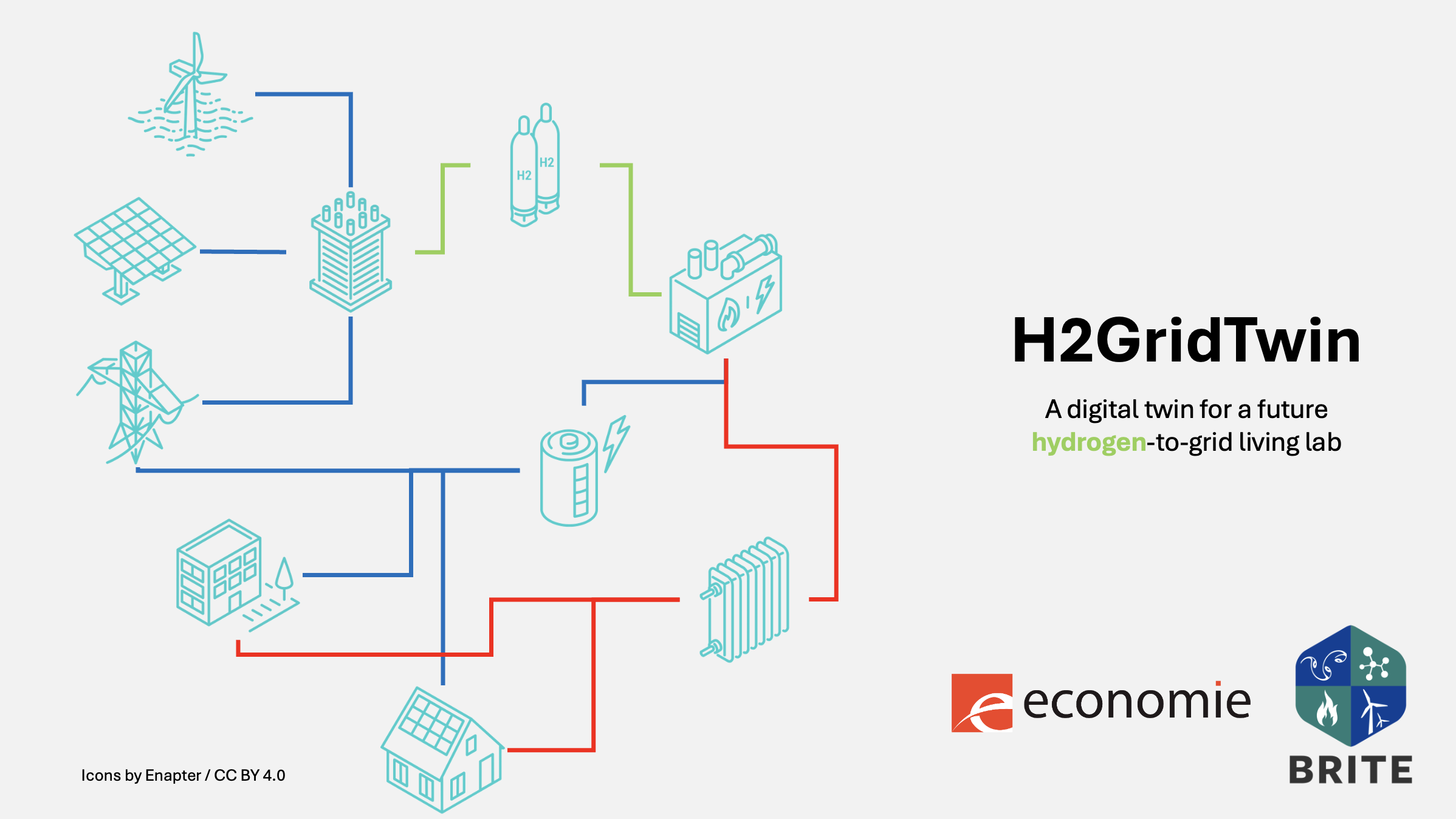
H2GridTwin is a research project developing a digital twin for a hydrogen-to-grid living lab, aiming to optimize the operation of a hydrogen-based energy system and maximize local green energy consumption. The project, funded by the Belgian federal Energy Transition Funds, integrates physically-informed models, experiments, and simulations across components such as electrolysers, micro-gas turbines, internal combustion engines, and heating networks.
By combining these models into a comprehensive digital twin, the project enables advanced control strategies and predictive operation of the full system. It is expected to support the design and operation of future hydrogen-based energy infrastructures efficiently and sustainably.
- Summary
-
The HECO2 project accelerates decarbonization in Wallonia's heavy industry through electrification, green hydrogen, hybrid plasmalysis, CCUS-compatible lime kilns, and post-combustion CO₂ capture. Integrates cross-sector partnerships and research to reduce industrial emissions.
- Description
-
HECO2 is a collaborative program targeting the decarbonization of heavy industry in Wallonia through innovative technologies and cross-sector partnerships. Coordinated by GreenWin and MecaTech and supported by regional partners, including research contributions from ULB, the project focuses on five main areas: electrification of high-temperature furnaces, production of green hydrogen via electrolysis, hybrid plasmalysis for methane conversion, development of CCUS-compatible lime kilns, and post-combustion CO₂ capture. By combining these approaches, HECO2 aims to significantly reduce industrial CO₂ emissions and accelerate the transition toward a sustainable, low-carbon industrial sector.
- Summary
-
Advances low-TRL technologies across the green hydrogen value chain in Wallonia, covering production, transport, storage, and utilization. Supports doctoral research, technology transfer, and regional leadership in the European hydrogen sector.
- Description
-
The TiNTHyN project is a collaborative research initiative aimed at advancing low-TRL (Technology Readiness Level) technologies across the entire green hydrogen value chain in Wallonia. Coordinated by UCLouvain and supported by a consortium of five universities, including ULB, four research centers, and several industrial partners, the project encompasses 12 doctoral theses addressing hydrogen production (via electrolysis and plasma processes), transport and storage (including novel materials and solid-state storage), and utilization (fuel cells, H₂-NH₃ combustion, and simulations).
As part of the e-WallonHY Strategic Innovation Initiative, TiNTHyN seeks to strengthen regional expertise, promote technology transfer, and position Wallonia as a leading player in the European hydrogen sector.
- Summary
-
Establishes a national hub for hydrogen research in Belgium, uniting 12 institutions to advance technology, training, and community building. Supports collaboration, knowledge exchange, and innovation across academia and industry.
- Description
-
BE-HyFE (Belgian Hydrogen Fundamental Expertise) is a collaborative academic project funded by Belgium's Energy Transition Fund, aiming to establish a national hub for hydrogen research. Coordinated by Ghent University, the initiative units 12 Belgian knowledge institutions to address both technological and societal challenges in the hydrogen sector. The project focuses on three main pillars: research, training, and community building. The project aims to create a sustainable academic network, linking hydrogen researchers across Belgium and facilitating collaboration with industry partners. This network is designed to be a lifelong resource for knowledge exchange and innovation.

- Summary
-
Advances Earth observation and reusable launcher technologies through collaborative research in Belgium. Integrates 30 PhD projects to develop innovative, sustainable solutions for space access and environmental monitoring.
- Description
-
Space4ReLaunch is a collaborative Belgian academic project focused on advancing Earth observation and reusable launcher technologies. Supported by the Walloon Region's SPW Economie Emploi Recherche, the initiative is structured around two complementary research axes:
Win4Space: Dedicated to Earth observation, this axis aims to develop innovative technologies for monitoring environmental and societal challenges.
Win4ReLaunch: Focused on reusable launchers, it seeks to create sustainable solutions for space access.
The project involves 30 PhD theses addressing cutting-edge technological challenges to meet industrial needs in the space sector. It fosters collaboration among universities, research centers, and the industrial sector to support high-end technological platforms and sustainable development goals.
- Summary
-
A EU's funding program that supports excellent science, global challenges, industrial competitiveness, and breakthrough innovation; funds research, training, partnerships and missions that align with EU policy goals (climate, digital, health, etc.)
- Description
-
Horizon Europe is the European Union's flagship research and innovation program for the period 2021-2027. Its main purposes are to tackle societal and global challenges (climate change, health, digital transformation, biodiversity, etc.); strengthen the EU's scientific and technological base and industrial competitiveness; support excellent science through eg the European Research Council, researcher training (Marie Skłodowska-Curie Actions), and infrastructure; foster breakthrough innovations and market-creating technologies via the European Innovation Council and innovation ecosystems.
The program is structured into three “Pillars”:- Excellent Science.
- Global Challenges & European Industrial Competitiveness.
- Innovative Europe, plus cross-cutting activities on widening participation and the European Research Area.